
Complete Guide to Tree Care in Savage, MN
Everything Savage homeowners need to know about tree care the Emerald Ash Borer situation, seasonal maintenance, removal costs, city rules and how to find a contractor you can actually trust.
Savage has been a Tree City USA member for over 30 consecutive years. That tells you something about how seriously this community takes its trees. It also means there are real rules around how tree work gets done here and real consequences for homeowners who ignore the problems building up in their yards.
This guide covers everything you actually need to know as a Savage homeowner the Emerald Ash Borer situation, what tree maintenance looks like across the seasons, how much removal costs in this market, what the city requires before any contractor picks up a chainsaw and how to avoid hiring someone who will make your situation worse. No filler. Just the information that matters for trees in this specific part of Scott County.
Savage and Its Trees
Savage sits in Scott County in the southwest Twin Cities metro. The city covers about 14 square miles of residential neighborhoods, newer developments and established streets lined with mature trees that have been growing for decades. The landscape here is genuinely urban forestry territory dense enough that tree problems become property problems fast.
The tree canopy in Savage faces two major threats right now. The first is the Emerald Ash Borer which has been spreading through Scott County for years and is actively killing off a significant portion of the city’s trees. The second is the weather Minnesota winters are genuinely hard on trees and Savage homeowners consistently discover spring damage they did not know had happened until the snow melts.
25%
Estimated ash tree coverage across Savage
30+
Years as Tree City USA member
55 ft
Average tree height in Savage MN
The Emerald Ash Borer Problem in Savage
The Emerald Ash Borer is a metallic green beetle originally from northeast Asia that was first detected in the United States in Michigan in 2002. It has been spreading ever since. By the time it reached Scott County it had already killed tens of millions of ash trees across North America and there is no sign of it slowing down.
The City of Savage estimates that up to 25% of all trees in the city are ash trees. That is a significant proportion and it means the EAB problem here is not a fringe issue affecting a handful of yards it is a citywide situation that most homeowners with mature trees will eventually deal with personally.
What makes EAB particularly destructive is how it works. The adult beetles lay eggs in the bark of ash trees. The larvae hatch and feed on the tissue just beneath the bark that carries water and nutrients up and down the tree. Over time this feeding disrupts the tree’s vascular system to the point where the tree can no longer sustain itself. By the time visible symptoms appear above ground the infestation is often already severe.
⚠️ Important for Savage homeowners
Private property ash trees are entirely the homeowner’s responsibility. The City of Savage will not remove them for you even if the tree is dying or dead. Waiting does not make this cheaper or easier — a dead ash tree becomes structurally unstable quickly and costs significantly more to remove once it is fully dead and brittle. It also becomes a genuine safety hazard the longer it stands.
- Savage and Its Trees
- The Emerald Ash Borer Problem in Savage
- How to Tell if Your Ash Tree Has EAB
- Treatment vs Removal – What Your Ash Tree Actually Needs
- The City of Savage Ash Tree Assistance Program
- Common Trees in Savage MN
- Seasonal Tree Maintenance Calendar for Savage
- Tree Removal – What the Process Actually Looks Like
- Tree Service Costs in Savage MN
- Storm Damage and Emergency Tree Response in Savage
- Frequently Asked Questions
How to Tell if Your Ash Tree Has EAB
Most homeowners notice something is wrong with their ash tree but are not sure whether EAB is the cause. These are the signs that point specifically to Emerald Ash Borer infestation rather than other tree diseases or weather damage.
D-shaped exit holes
The most definitive sign. Adult beetles emerge through D-shaped holes roughly 4mm wide in the bark. If you see these your tree is already heavily infested.
S-shaped galleries
If you peel back a section of bark you will see serpentine galleries carved by the feeding larvae. These cut off the tree’s vascular flow.
Crown dieback
Branches at the top of the tree start dying first. The dieback works its way downward as the infestation progresses. A tree losing its upper canopy while lower branches still look green is a classic EAB pattern.
Bark splits
Vertical cracks in the bark often develop over the galleries as the tree attempts to grow around the damage. These splits are particularly visible in the upper trunk.
Woodpecker activity
Woodpeckers feed on EAB larvae beneath the bark. Heavy and unusual woodpecker activity on the upper trunk of an ash tree is a strong indicator of infestation even before other symptoms appear.
Epicormic sprouting
Clusters of small shoots growing directly from the base of the trunk or from large lower branches indicate the tree is under severe stress and attempting to compensate for canopy loss.
Treatment vs Removal – What Your Ash Tree Actually Needs
Treatment is possible but only works under specific conditions. An ash tree can be treated with systemic insecticides if it is still in good overall health and the infestation has not progressed beyond roughly 30 to 50 percent of the crown. Treatment needs to be applied on a regular schedule typically every one to two years depending on the product and it is an ongoing cost not a one-time fix.
If your ash tree is already showing significant crown dieback, has visible D-shaped exit holes across a large portion of the bark or has been in decline for more than one season, treatment is unlikely to save it. At that stage removal is the only realistic option. The longer you wait on a tree that has crossed that threshold the more dangerous and expensive the removal becomes. A living ash tree with EAB can be felled in a controlled manner. A dead and brittle ash tree requires more complex rigging and carries greater risk of unpredictable failure during the job.
The City of Savage Ash Tree Assistance Program
The City of Savage has two programs to help residents manage the cost of tree removal on private property.
The first is a preferred contractor arrangement. The city has negotiated discounted rates with Carr’s Tree Service. If you contact Carr’s directly and mention the City of Savage preferred contractor pricing you will receive their negotiated rate. You are not required to use this contractor, you can get quotes from others but it is worth a call for comparison.
The second is financial assistance for hazardous trees. If a tree on your private property poses a genuine safety risk or could cause property damage you may qualify for up to $2,500 in city assistance toward the removal cost. Contact the City of Savage directly to assess whether your tree qualifies. Not every tree removal qualifies the city looks for documented hazard rather than just general decline.
For disposal of EAB-infested wood Savage residents can use the Shakopee Mdewakanton Sioux Community Organic Recycling Facility at 1905 Mystic Lake Drive South in Shakopee. There is a nominal fee. Do not transport infested wood outside the local area this is how EAB spreads to new regions.
Common Trees in Savage MN
Knowing what trees you have in your yard helps you understand what maintenance they need and what threats they face. These are the most commonly found trees in Savage and the surrounding Scott County area.
Green Ash / White Ash
The most threatened tree in Savage. Once widely planted as a street and yard tree. Now facing near total loss from EAB across the metro.
American Elm
A large shade tree common in older Savage neighborhoods. Susceptible to Dutch Elm Disease though DED-resistant varieties exist. Average height 60 to 80 feet.
Boxelder
A fast growing maple species that grows abundantly throughout Scott County. Often considered weedy but provides canopy quickly. Prone to storm breakage due to weak wood structure.
Eastern Hophornbeam
A smaller understory tree found throughout the Savage area. Extremely hard wood, slow growing, very tolerant of poor soils. Generally low maintenance.
Silver Maple
Common in residential areas throughout the Twin Cities metro including Savage. Fast growing but structurally weak large limbs are prone to splitting in ice storms and heavy snow.
Bur Oak
A native Minnesota oak that is extremely long-lived and drought tolerant. Oak wilt is a concern never prune oaks between April and July when the disease is most transmissible.
Seasonal Tree Maintenance Calendar for Savage
Minnesota trees face genuinely different stresses each season. What you do and when you do it? matters more here than in milder climates. This calendar reflects what actually makes sense for trees in Savage specifically.
Spring – March to May
- Assess winter damage as snow melts look for cracked limbs, lifted roots and frost heaving
- Prune flowering trees after they bloom
- Do not prune oak trees after April, oak wilt risk is high April through July
- Apply EAB treatment to ash trees in late spring when trees are actively growing
- Schedule non-emergency removal before summer backlog builds
Summer – June to August
- Avoid pruning oaks entirely peak oak wilt transmission period
- Watch for signs of drought stress wilting leaves, early color change, leaf drop
- Inspect for insect activity including Japanese beetles and EAB adult emergence
- Deep water newly planted trees during dry spells
- Storm season inspect trees after significant wind or hail events
Fall – September to November
- Best time to prune most species, trees are entering dormancy, disease transmission is low
- Remove dead or hazardous branches before winter ice loads add weight
- Assess ash trees before leaf drop, EAB signs are easier to spot with leaves on
- Schedule removal jobs early fall fills up fast before ground freezes
- Mulch around tree bases before freeze to protect roots
Winter – December to February
- Excellent time for tree removal frozen ground protects lawn from equipment damage
- Dormant pruning for most species clean cuts heal well in spring
- Inspect after ice storms for cracked limbs and split crotches
- Avoid shaking snow off branches manually the stress of the action can cause more damage than the snow weight
- Faster scheduling winter is the slowest season for most contractors
The winter removal advantage most Savage homeowners do not know about: When the ground is frozen your lawn takes almost no damage from heavy equipment. In spring and summer a crane or skid steer working in your yard will leave serious ruts. In January it drives across frozen ground and leaves nothing behind. If you have a tree that needs to come down and your lawn matters to you, winter is the right time to do it.
Tree Removal – What the Process Actually Looks Like
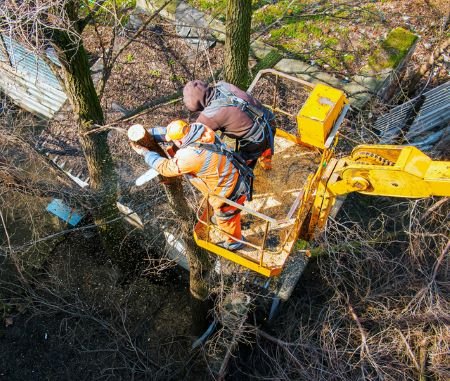
Tree removal is one of those jobs where the gap between doing it right and doing it wrong is enormous. A tree coming down without proper planning and rigging can destroy a fence, a car, a roof or injure someone standing nearby. Understanding what a proper removal involves helps you evaluate the contractors you talk to.
A legitimate tree removal in Savage starts with a site assessment before any equipment comes out. The crew looks at the tree’s lean, the condition of the wood, what is in the fall zone, proximity to structures, power lines and neighboring properties and what equipment they will need. For a straightforward tree in an open yard this takes ten minutes. For a large tree over a roof it can take longer and may involve a crane.
The removal itself uses one of two approaches depending on the situation. A controlled fell brings the whole tree down in one or two pieces to a predetermined landing zone. This requires enough clear space and is the faster and cheaper option. When space is tight near structures, fences or power lines the crew climbs and pieces the tree down section by section using ropes and rigging to control each piece as it comes down. This takes longer and costs more but is the right call when the alternative is risking property damage.
After the tree is down the debris gets chipped or hauled away. A reputable crew leaves your yard clean. If you want firewood sectioned and left on site just mention it before the job starts most crews are happy to accommodate that.
Tree Service Costs in Savage MN
Pricing varies based on tree size, species, location relative to structures and how accessible your yard is. These ranges reflect the actual Savage and Scott County market not national averages that often understate what work costs in Minnesota.
| Service | Typical range | Notes |
|---|---|---|
| Tree removal — small (under 30 ft) | $250 – $500 | Ornamental trees, young trees, clear access |
| Tree removal — medium (30–60 ft) | $500 – $1,000 | Average Savage residential tree |
| Tree removal — large (60 ft+) | $1,000 – $2,000+ | Large elms, oaks, mature ash trees |
| Stump grinding | $100 – $400 | Average in Savage is $196 |
| Tree trimming and pruning | $200 – $800 | Depends on tree size and number of cuts |
| Emergency tree removal | $500 – $2,500+ | Average in Savage is $950 |
| EAB treatment (annual) | $100 – $300 | Per tree, depends on trunk diameter |
The factors that push costs toward the higher end of each range are trees near structures or power lines which require slower piece-by-piece removal, limited access that prevents equipment from getting close to the tree, dead or brittle wood which is more unpredictable and dangerous to work with and emergency timing which adds an after-hours premium.
Getting multiple quotes is always worth doing for large jobs. That said the cheapest quote is not always the right choice an uninsured crew that damages your property or injures someone in your yard will cost you far more than the difference between bids.
Storm Damage and Emergency Tree Response in Savage
Savage sits in Scott County which sees real weather. Summer thunderstorms between June and August regularly bring straight-line winds strong enough to take down limbs and uproot shallow-rooted trees. Ice storms between October and March add weight to branches until they fail. The freeze-thaw cycles through February and March stress root systems and crack wood that was weakened during winter.
After a major storm the immediate priorities are safety and documentation. Before anyone touches a downed tree assess the scene. Check whether any utility lines are involved if a tree has brought down a power line do not approach it and call Xcel Energy before calling a tree service. If the tree is on your roof do not go into the part of the house the tree has hit until the structural situation is assessed.
Document everything with photographs before any work starts. Your homeowner’s insurance may cover storm damage tree removal and they will want documentation of how the tree fell and what it damaged. Call your insurance company before you call a contractor for storm-related work and ask whether removal is covered under your policy.
For trees that are actively dangerous blocking a driveway, resting against a structure or threatening to fall call an emergency tree service. Legitimate emergency services in the Savage area respond within hours. Be cautious of storm chasers who appear door-to-door after major weather events offering cash discounts for immediate work these operations frequently overcharge and do poor quality cleanup.
Frequently Asked Questions
Do I need a permit to remove a tree in Savage MN?
For trees on your private property you generally do not need a removal permit. However the contractor doing the work must be registered with the City of Savage. Boulevard trees between the sidewalk and the street are city property and require city approval before any work is done on them.
Does the City of Savage help pay for tree removal?
Yes. The city offers up to $2,500 in financial assistance for hazardous tree removal on private property. The tree must pose a documented safety risk or threat of property damage to qualify. The city also has a preferred contractor program with Carr’s Tree Service that offers negotiated discounted rates to residents.
How much does tree removal cost in Savage MN?
The average tree removal in Savage costs around $635 for a standard residential tree. Small trees under 30 feet typically run $250 to $500. Medium trees from 30 to 60 feet run $500 to $1,000. Large trees over 60 feet cost $1,000 to $2,000 or more. Emergency removal averages $950. Get a free on-site estimate for an accurate price on your specific tree.
How do I know if my ash tree has Emerald Ash Borer?
The most definitive sign is D-shaped exit holes in the bark roughly 4mm wide. Other signs include S-shaped galleries under the bark if you peel a section back, crown dieback starting at the top of the tree, unusual woodpecker activity on the upper trunk and small shoots sprouting from the base. If you see these signs have the tree assessed as soon as possible.